
How to Create a Family Homework System That Reduces Stress and Improves Focus
Table of Contents
- Why a Family Homework System Matters
- Step 1: Set Up the Right Homework Environment
- Step 2: Build a Simple Daily Routine
- Step 3: Use Consistent Family Rules and Expectations
- Step 4: Create a Homework Planning Habit
- Step 5: Support Focus with Breaks and Transitions
- Step 6: Track Progress Without Adding Pressure
- How to Adapt Your Family Homework System for Different Ages
- Common Homework Problems and How to Solve Them
- How Homework Fits Into the Rest of Family Life
- Conclusion
Why a Family Homework System Matters
A strong family homework system can turn evening chaos into a calmer, more predictable part of the day. Instead of constant reminders, last-minute searching for worksheets, and emotional arguments over unfinished assignments, your family gets a repeatable process that helps everyone know what to do, when to do it, and where to find what they need.
For many households, homework stress is not really about the homework itself. It is usually about missing supplies, unclear expectations, distracted kids, tired parents, and competing priorities after school. A well-designed family homework system reduces decision fatigue, improves focus, and helps children build responsibility without parents having to micromanage every step.
The best part is that it does not need to be complicated. You do not need a perfect desk setup or a strict schedule that feels rigid. What you need is a simple structure that fits your family’s energy, school demands, and home routines. If you already use a [LINK_TO: How to Set Up a Family Calendar System That Everyone Actually Uses], a homework system becomes even easier to maintain because everyone can see what is due and when.
Step 1: Set Up the Right Homework Environment
The first step in any effective family homework system is creating a space that supports concentration. This does not have to be a separate study room. A kitchen corner, dining table, or shared desk can work well if it is organized and consistent.
What a good homework space needs
- Good lighting so children can read and write comfortably
- Basic supplies such as pencils, erasers, rulers, paper, and chargers
- Low clutter to reduce distractions and visual stress
- Clear boundaries so the homework area is not confused with playtime
- A calm atmosphere with less background noise during homework time
If your household is busy, a shared homework station can save time. Keep it stocked with the essentials so nobody has to hunt for scissors or glue sticks halfway through an assignment. You can also keep a basket for school papers, notes from teachers, and books that need to go back to class.
For families who already rely on a [LINK_TO: How to Create a Household Command Center That Keeps Your Family on Track], adding a homework bin or shelf to that area can make everything easier to manage. A central location means school items stay visible and are less likely to get lost in the home.
Step 2: Build a Simple Daily Routine
A family homework system works best when homework happens at a predictable time. Children do better when they know homework is part of the day rather than a surprise task that appears whenever everyone feels like it.
Pick a time that matches your family’s natural rhythm. Some children focus best right after a snack and short break after school. Others need time to decompress before they can concentrate. The goal is to make homework a habit, not a battle.
Examples of homework routine options
- After-school reset first: snack, rest, bathroom break, then homework
- Early evening routine: homework before dinner while energy is still available
- Two-part routine: a short block before dinner and a second block after
Keep the routine short and realistic. A young child may only need 20 to 30 minutes of focused work, while an older student may need longer blocks with breaks. The important thing is consistency. A routine becomes easier to follow when it happens at the same time most days.
If you already have a [LINK_TO: How to Create a Family Morning Routine System That Gets Everyone Out the Door on Time], use the same thinking for afternoons and evenings: simplify the sequence, reduce friction, and make expectations visible.
Step 3: Use Consistent Family Rules and Expectations
Clear rules help a family homework system work smoothly. When expectations are vague, parents end up repeating themselves, and children may resist because they do not know what is really required.
Helpful homework rules to consider
- Homework starts at the agreed time
- Devices are put away unless needed for schoolwork
- All needed materials are gathered before starting
- Questions are asked after trying independently first
- Finished work is checked and packed into the school bag immediately
Keep your rules few, simple, and easy to remember. Too many rules create confusion, especially for younger children. It helps if the adults in the home respond the same way every day. Consistency reduces negotiation and gives children a sense of security.
Try to frame rules as support rather than punishment. For example, instead of saying, “No screens because homework is a chore,” say, “We put devices away so your brain can focus better and you can finish faster.” This makes the system feel helpful instead of controlling.
Step 4: Create a Homework Planning Habit
One of the biggest sources of homework stress is uncertainty. A strong family homework system includes a simple planning habit so tasks do not pile up unnoticed.
At the start of each week, or every evening, review upcoming assignments, test dates, reading goals, and project deadlines. This gives your family a chance to spot busy days early and avoid last-minute pressure.
A simple planning checklist
- Check the planner or school portal
- Identify urgent assignments
- Break big projects into smaller steps
- Place due dates on a family calendar
- Pack completed work into the school bag
This habit works especially well when paired with a [LINK_TO: How to Create a Family Weekly Planning Meeting That Actually Sticks]. Even a five-minute weekly check-in can help children learn how to manage responsibilities more independently.
Parents should aim to guide, not do the homework planning for the child. The goal is to teach ownership. Over time, children learn how to estimate effort, anticipate deadlines, and prioritize work. These skills matter far beyond school.
Step 5: Support Focus with Breaks and Transitions
Focus is easier when children are not expected to work for too long without a reset. A family homework system should include planned breaks, especially for younger children or those who struggle with attention.
Short breaks can help children return to tasks with better energy and less frustration. The key is to keep breaks intentional, not open-ended.
Break ideas that work well
- Stretching for two minutes
- Drinking water
- Walking around the house once
- Using the bathroom
- Taking a brief snack break
Avoid switching into high-stimulation activities like games, videos, or social media during breaks, because those can make it harder to refocus. Instead, use calm transitions that help the brain reset.
For children who are easily overwhelmed, it can help to use a timer. A visible timer creates structure and removes the need for repeated reminders. Older children may prefer to manage their own timing, which builds responsibility and self-awareness.
Step 6: Track Progress Without Adding Pressure
Tracking homework completion can be motivating, but it should not become another source of stress. The purpose of tracking in a family homework system is to build awareness and consistency, not to shame or punish.
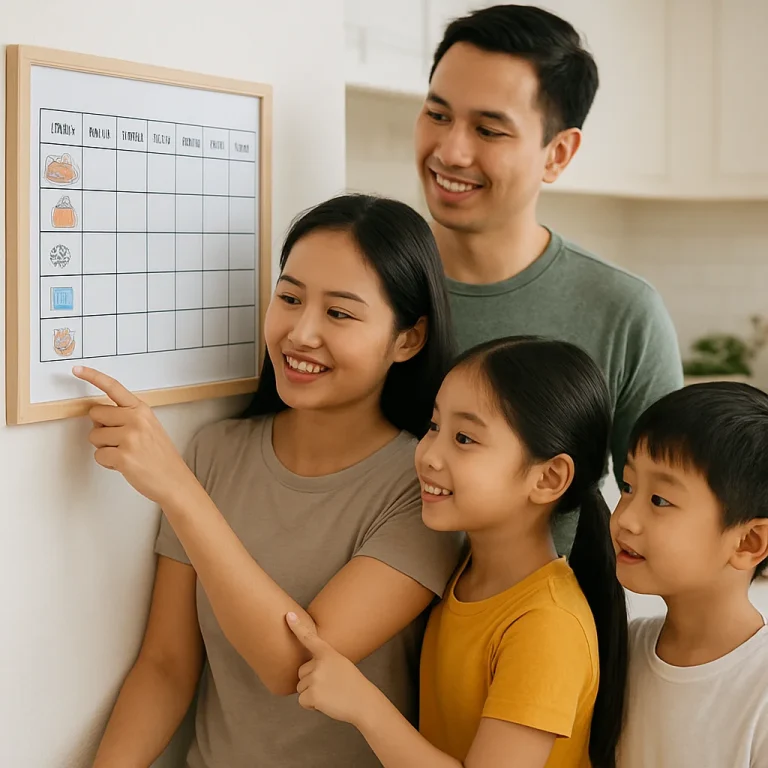
Simple tracking methods include a wall chart, checklist, or weekly review. Younger children often respond well to visible progress. Older students may prefer a private planner or app.
What to track
- Homework started on time
- Work finished without reminders
- Materials packed for school
- Reading completed
- Projects broken into smaller steps
Celebrate consistency, not perfection. A child who starts homework on time four days out of five is building a strong habit. Positive reinforcement works better than constant correction. Praise effort, independence, and improvement.
If your family already uses a [LINK_TO: How to Create a Family Organization System That Keeps the Whole House Running Smoothly], connect homework tracking to the same household structure so it feels like part of normal life, not an extra task.
How to Adapt Your Family Homework System for Different Ages
Every age group needs a slightly different approach. A good family homework system grows with your children so it stays useful over time.
For younger children
- Use short work sessions
- Stay nearby for guidance
- Keep directions simple
- Use visual reminders and checklists
For primary school children
- Teach them to unpack and repack their school bag
- Encourage them to read instructions aloud
- Let them cross off completed tasks
- Use a homework folder or tray
For older children and teens
- Encourage self-management
- Review deadlines weekly
- Support time estimation
- Allow more independence while staying available for help
Teenagers may resist direct supervision, but they still need structure. Instead of controlling every step, focus on accountability and planning. This is also a good time to connect homework habits with broader life skills like time management, budgeting, and personal responsibility.
Common Homework Problems and How to Solve Them
Even a well-designed family homework system will face setbacks. The goal is not to eliminate every issue, but to respond in a way that keeps the routine moving forward.
Problem: Homework is forgotten at school
Solution: Create a “school bag check” before leaving school and again before bedtime. Keep a packing checklist near the door or homework station.
Problem: Children procrastinate
Solution: Shorten the start-up process. Remove distractions, set a timer, and begin with the easiest task to build momentum.
Problem: Parents end up doing the work
Solution: Offer help with understanding, not with completing the assignment. Ask guiding questions instead of giving answers.
Problem: After-school meltdowns
Solution: Add a decompression period with snack, water, and quiet time before homework begins. Some children need a transition before they can focus.
Problem: Different children need different support
Solution: Use a flexible core routine with age-appropriate adjustments so the whole family can stay on the same page without forcing everyone into the same method.
How Homework Fits Into the Rest of Family Life
The strongest family homework system is one that works with the rest of your home routines, not against them. If dinner, chores, bathing, and bedtime are all competing with homework, stress will rise quickly.
That is why it helps to connect homework with other systems in the home. A [LINK_TO: How to Create a Family Meal Planning System That Saves Time, Money, and Stress] can protect homework time from dinner chaos. A [LINK_TO: How to Create a Family Chore System That Actually Gets Done Every Week] can stop chores from piling up during the same hour. A [LINK_TO: A Simple Weekly Reset Routine That Makes Monday Feel Easier] can help clear out school papers and refresh supplies before the new week begins.
You can also support homework by keeping school documents, permission slips, and notices in one place. A [LINK_TO: How to Create a Home Paperwork System That Prevents Lost Documents] or [LINK_TO: How to Create a Family Information Binder That Everyone Can Use] can make school life feel much less frantic.
When homework is treated as one part of a larger household rhythm, the whole family benefits. Less searching, fewer surprises, and better follow-through create a calmer environment for everyone.
Conclusion
A thoughtful family homework system does more than get schoolwork finished. It builds calm, structure, independence, and confidence. When children know where to work, when to start, what to do, and how to stay on track, homework becomes far less stressful for the entire household.
Start small: create a homework spot, choose a consistent routine, set a few clear rules, and review assignments regularly. Then adjust the system as your children grow and your family’s needs change. The goal is not perfection. The goal is a repeatable routine that supports focus and makes evenings smoother.
Ready to make homework easier at home? Start building your family homework system today, and explore more family routines and organization guides from KnowMeal to create a calmer, better-run home.